
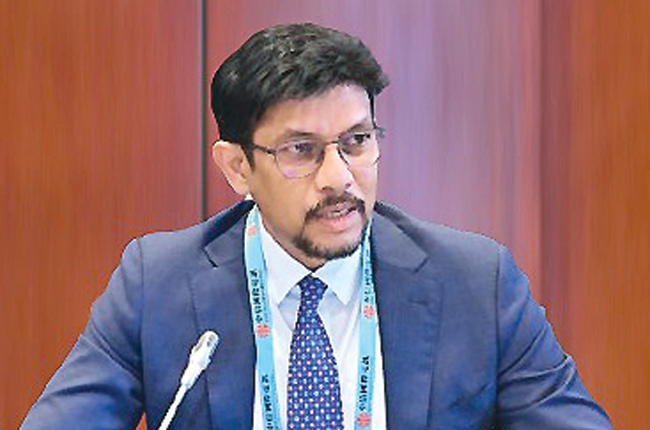
Sri Lanka has outlined an ambitious vision to transform itself from a consumer of artificial intelligence (AI) technologies into a trusted regional producer and partner in the global digital economy, said Deputy Minister of Digital Economy Eranga Weeraratne addressing the GSMA Roundtable at MWC Shanghai 2026.
Speaking at the session themed “Powering the AI Economy: Computing–Network Synergy,” Weeraratne said Sri Lanka aims to become a strategic hub for AI, digital infrastructure and cross-border collaboration by capitalising on its geographic location, digital connectivity, renewable energy ambitions and skilled workforce.
Emphasising that the future of AI depends not only on software but also on physical infrastructure such as submarine fibre-optic cables, cloud platforms, data centres, cybersecurity systems and reliable energy supplies, he said Sri Lanka is well positioned to play a key role in the region’s evolving AI ecosystem. The Deputy Minister noted that multiple international submarine cable systems, including SEA-ME-WE 3, 4, 5 and 6, together with the India Asia Xpress (IAX), pass through Sri Lanka, making the island a critical digital gateway linking Europe, the Middle East and Asia. He also highlighted that Sri Lanka hosts South Asia’s first submarine cable depot, strengthening its position as a regional digital infrastructure hub.
The country’s AI strategy focuses on developing an integrated ecosystem combining connectivity, advanced computing, trusted governance, cybersecurity and renewable energy to support AI innovation while ensuring greater digital sovereignty. Rather than advocating technological isolation, Sri Lanka’s concept of sovereign AI seeks to safeguard sensitive national data, promote AI systems that understand local languages and cultures, and maintain resilient digital infrastructure, while encouraging international collaboration.
Weeraratne proposed regional cooperation in seven priority areas, including sovereign AI, affordable and inclusive AI, green computing, local-language AI models, AI literacy, cyber resilience and computing-network synergy. Highlighting Sri Lanka’s target of generating 70 percent of its electricity from renewable sources by 2030 and achieving carbon-neutral electricity generation by 2050, he said sustainable infrastructure would provide a competitive advantage for attracting global technology investments.
Inviting governments, technology companies, investors and research institutions to partner with Sri Lanka, the Deputy Minister said the country seeks to become a trusted platform where innovation, infrastructure and international cooperation converge to shape Asia’s AI future.
Source : Daily News