
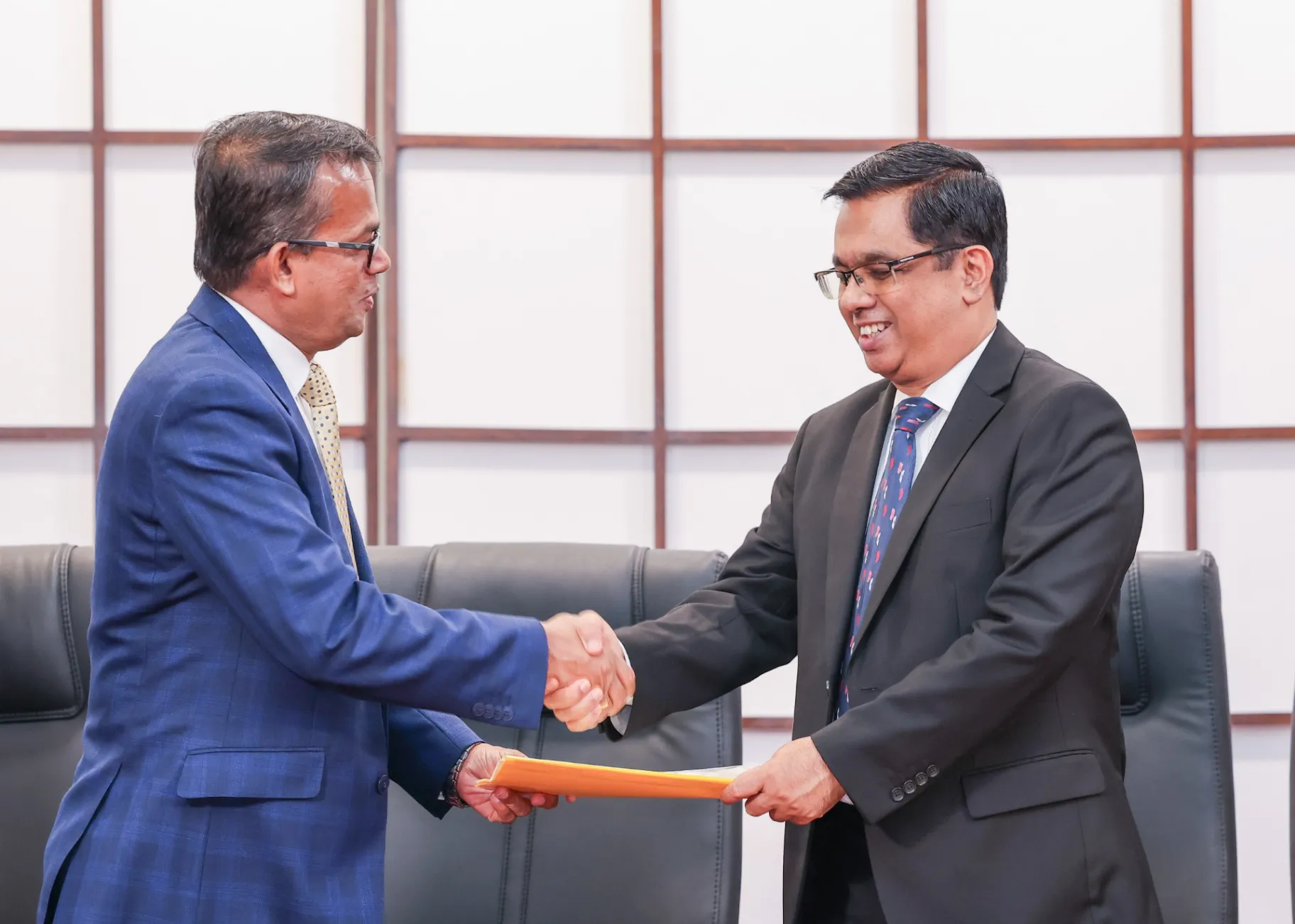
Demonstrating its commitment to environmental sustainability and wildlife conservation, People’s Bank has launched a pioneering Corporate Social Responsibility (CSR) initiative aimed at minimizing elephant–train collisions in Sri Lanka.
The project, fully funded by People’s Bank, is implemented in collaboration with Clean Sri Lanka, Sri Lanka Railways, the Department of Wildlife Conservation and the Department of Forest Conservation, and brings together advanced technology and conservation expertise to address one of the country’s most critical wildlife conservation challenges.
This initiative is also aligned with the Government’s Clean Sri Lanka Programme, supporting its broader vision of creating a sustainable and environmentally responsible nation. Initiating a three-year project to make this vision a reality, People’s Bank, Sri Lanka Railways, the Department of Wildlife Conservation and the Department of Forest Conservation officially signed an MOU on 1st September 2026.
Secretary to the President Dr. Nandika Sanath Kumanayake, People’s Bank’s Chairman Chandana Guniyangoda, Chief Executive Officer/General Manager Clive Fonseka, Members of the Board of Directors of People’s Bank and other officials participated in the event.
The Elephant–Train Collision Prevention Project seeks to significantly reduce elephant fatalities caused by train collisions through the deployment of an advanced Early Warning System at identified high-risk railway locations. The innovative system combines ground vibration sensors, acoustic sensors, FMCW radar, thermal and beam sensors, supported by solar power and long-range wireless communication (LoRa), to detect and confirm elephant movements on or near railway tracks. Once an elephant is detected within a defined danger zone, the system provides timely warnings through trackside warning lights, in-cab alerts for train drivers and notifications to the railway control system, giving railway personnel valuable additional time to respond
The project will be implemented through a collaborative effort among the key stakeholders, each undertaking distinct responsibilities to ensure its success and long-term sustainability. As the principal financier, People’s Bank will fund the procurement and installation of advanced technological infrastructure and essential equipment required for the project.
Sri Lanka Railways will support construction of the necessary infrastructure, implement speed control measures, multi-aspect signalling systems, and train locomotive drivers to adhere to enhanced safety protocols in identified high-risk areas.
The Department of Wildlife Conservation will focus on habitat management initiatives, including the creation of artificial water sources and increasing food availability within forest habitats to reduce elephant movement near railway tracks. A Centralised Monitoring Station will oversee the operation of the system through regular performance monitoring, fault detection, maintenance coordination, and reporting.
In addition, Sri Lanka Railways, the Department of Wildlife Conservation and the Department of Forest Conservation will conduct awareness and educational programmes targeting railway personnel, local communities, and the general public to enhance understanding of elephant conservation and support for the proposed solution.
A total of 39 critical locations spanning approximately 89 kilometres of railway track have been identified as collision hotspots requiring the installation of the Early Warning System. During the first phase of the project, People’s Bank will fund the installation of 13 systems at priority locations identified by the Department of Wildlife Conservation.
As the next step of the initiative, a pilot project will be implemented along a 14-kilometre railway stretch between Habarana and Hataraskotuwa, one of the most vulnerable areas for elephant–train collisions in the country.
People’s Bank Chairman Mr Chandana Guniyangoda stated:
“As a state-owned bank, People’s Bank is proud to support this vital national initiative. By bringing together technology, collaboration, and conservation, we aim to contribute towards protecting Sri Lanka’s elephant population while enhancing railway safety and promoting sustainable development.”
People’s Bank Chief Executive Officer/General Manager Clive Fonseka added:
“The elephant population is an invaluable asset of our nation, and preserving it is a cause that brings the entire nation together. As the pride of the nation, People’s Bank considers this initiative a national responsibility that reflects People’s Bank’s commitment to environmental sustainability and responsible corporate citizenship. Through our partnership with the Department of Wildlife Conservation, Department of Forest Conservation, and Sri Lanka Railways, we are supporting an innovative solution that will help reduce elephant fatalities and promote safer railway operations.”
Sri Lanka is home to one of the world’s most significant populations of Asian elephants, a keystone species that holds immense ecological, cultural, and economic value. However, rapid urbanisation and infrastructure development have increasingly fragmented elephant habitats, intensifying human–elephant conflict and exposing elephants to greater risks.
The country’s elephant population, estimated at 5,879 in 2011, has declined to approximately 4,000 in 2024. Alarmingly, 386 elephant deaths were recorded during 2024 alone. While train collisions did not account for the majority of these deaths, railway lines traversing elephant habitats in the North Central, Eastern, and Southern Provinces have become major collision hotspots, with statistics identifying 39 locations where the majority of such incidents occur.
Recognizing the urgency of addressing this issue, People’s Bank initiated discussions with officials of the Department of Wildlife Conservation to evaluate practical and sustainable solutions. During these consultations, a technology-driven Early Warning System that had previously demonstrated encouraging results emerged as a promising solution.
The system was designed by elephant conservationist and engineer Irosh Perera. Subsequently, officials attached to the Clean Sri Lanka Programme facilitated a series of discussions at the Presidential Secretariat involving representatives from the Department of Wildlife Conservation, Department of Forest Conservation, Sri Lanka Railways, People’s Bank, and the designer of the solution to establish the project framework, implementation strategy, and key milestones.
Through this landmark CSR initiative, People’s Bank continues to reaffirm its commitment to sustainable development, environmental conservation, and national progress, contributing meaningfully towards protecting Sri Lanka’s iconic elephant population while promoting safer railway operations for generations to come.
Source: The Morning